Our salon cushions and upholstery are gross. They are ugly, old, no longer very supportive, have lost their shape, are thread-barren, filthy, and smell like mold. I decided to give our salon a major face-lift and replace and reupholster our cushions.
 |
| Our GROSS old cushion and upholstery |
I have never done any upholstery work, and had very limited experience sewing. Since sewing scrunchies in 8th grade home economics class over 20 years ago, I just recently got back into sewing so I could save money and do lots of projects aboard our sailboat.
I purchased a LSZ-1 sewing machine from Sailrite a few months ago and have completed a couple of projects using my Sunbrella Marine Fabric in Forest Green from Sailrite including a generator cover, a helm cover, a splash guard for the aft companion way, lee cloths, and a sail bag.
 |
| My Sailrite LSZ-1 Walking Foot Sewing Machine |
 |
| The generator cover I made |
 |
| I made a helm cover |
 |
| I made a splash guard for our aft companion way |

The sail bag I made for our mainsail

Realizing that I had zero knowledge about how to do a new cushion and upholstery project, I began by reading, researching, and watching videos. I have included links to the most helpful information I found. Not surprisingly, I watched lots and lots of Sailrite instructional videos. They have a ton of them on all sorts of sewing projects, and I don't think I would have the courage or skills to do any sewing projects without them!
Eisenberg Upholstery: Understanding foam density & firmness
Carrs Corner: A complete education about cushion foam
It is very important to understand some foam terminology before making your decision on which foam to use for your project. It may seem overwhelming at first, but soon you will understand what all of this means and be able to choose your ideal foam.
Closed cell foam - Each individual cell is closed off from the others, meaning that water cannot penetrate the foam. This foam floats, typically pretty hard, and is recommended for boat cockpits. It is typically more expensive than open cell foam because of its higher density.
Open cell foam - Each cell is open, and moisture can penetrate it and potentially be trapped in it. It is softer than closed cell foam, and recommended for use inside where it will not be exposed to much moisture. It can, however, be covered with a moisture barrier to help with potential moisture related problems such as mold, mildew, and bacteria.
Biocide - a treatment added to some foams in the manufacturing process to prevent mold and mildew.
Dry fast foam - It's an open cell foam with its cell walls removed. It is extremely porous, so water can run right through it rather than be absorbed into it. It is significantly more expensive than regular open cell foam. Good for outdoor applications, or places where it is likely to get wet.
Foam density - Pounds polyurethane per cubic foot. Higher density foam is considered higher quality and will typically last longer than lower density foams.
Indentation Load Deflection - The force in pounds required to compress the foam by 25%. The higher the ILD number, the firmer the foam. The lower the ILD number, the squishier the foam.
Memory Foam - A polyurethane foam with added chemicals to increase its viscosity and density. It conforms to the body and reacts to body heat, helping to warm you. Not recommended in hot environments.
After my research I decided that I wanted an open cell 5" foam with a density over 2.3 lbs, an ILD rating of 35-50 lbs, and a long life. I also decided that DryFast foam would not be necessary, since it would be used inside and it would not be exposed to water. Some articles I read recommended more firm foam for the seat cushions than the backs, but I wanted the same foam for both the seats and seat backs because my settee converts to a bed. It would not be comfortable for sleeping if the cushions were not all uniform.
I really wanted to buy my foam from Sailrite because I have benefited so much from their products and instructional videos, but unfortunately they didn't offer foam in the sizes, density, and ILD rating that I was looking for.
After searching all over the internet and comparing prices and quality, I decided to order foam from the Foam Factory. Tiffany was the sales rep who helped me. She was very kind and tolerant of my numerous questions, the headache of figuring out shipping to the Virgin Islands, and she even advised me on which foam I should get.
I originally picked out the 5" LuxHQ foam. It has an ILD rating of 50, and Tiffany warned me that this is very firm, almost like sitting on the ground. Yikes! I don't want that! So I picked out the HD36 high quality foam instead. It has an ILD rating of 35, so it would feel more comfortable.

The prices I found on their website were significantly better than anything else I was able to find online. It was $205.99/sheet. The foam density of 2.8lbs/cubic ft was in the range I was looking for (2.3lbs/cubic feet or higher). The Indentation Load Deflection (35 lbs) was in my desired range. The foam comes in big sheets (82" x 76") so I won't need to puzzle piece my cushions together and can have some long cushions. And it's rated to have a typical life of 12-18 years.
After I figured out what foam I would use, it was time to do some research on fabric. I've included links to the most helpful videos and articles that I found.
But after some more consideration, I changed my mind and decided to go with Sunbrella Upholstery Fabric in Dupione Paradise because it has more of a texture to it and I think it would look more classy and not show stains as well.
Now that I knew what foam and fabric I wanted to buy, it was time to figure out how much of it I should order. I found a video that helped me take measurements.
I found a website with a great calculator to help you figure out how lay out your cuts to get the right size pieces with minimal waste. You just input the dimensions of your starting piece, input the dimensions of your individual pieces, and then it lays it all out for you in the best way.
I was wondering if I would be able to cut the foam myself, or if I would need to get it custom cut (for a significant increase in price). I found a great Sailrite video showing how easy it is to cut foam yourself using an electric kitchen knife, purchased from any store selling kitchen products for around $15.
I was curious how you get the foam into the fabric, and I found this Sailrite video:
To figure out how much fabric I would need to purchase, and later, to figure out how I should cut it, I used Sailrite's handy FABRIC CALCULATOR
I decided to buy Sailrite's Edge Hotknife Package to make my life much easier, and to prevent unraveling of the edges of my fabric over time.

I also decided to add polyester batting to my cushions so they would be more comfortable and less boxy. I took measurements and estimated I'd need 13 yards.

I decided to get cushion wrap silk film to use as a moisture barrier around my cushions, to prevent mold and mildew.


I plan to use a zipper on one of the edges of each cushion, so I measured and estimated that I'd need around 50 feet for my cushions and some throw pillows. I decided to go with YKK® Zipper #5 Vislon® Continuous White because it wouldn't corrode and #5 is a good size for cushions. I also ordered 20 YKK® Slider #5 Vislon® White Plastic Single Non-Locking Pulls.


I decided that I wanted to have piping around the perimeter of my cushions to give them more of a professional look. You can buy pre-made piping in a limited number of colors and styles, but it is not cheap. I decided to make my own piping, using Sailrite's 5/32" foam piping and a slightly different but coordinating fabric, Sunbrella Canvas Parrot Upholstery Fabric. I found a photo on Amazon of a throw pillow that was upholstered in Dupione Paradise fabric with Parrot piping, and was convinced that these two fabrics would be a great combination for my cushions.

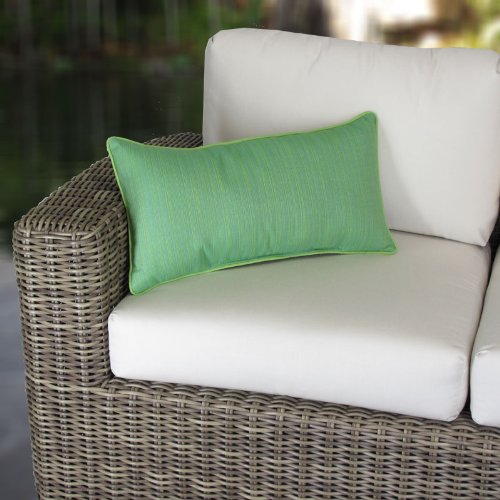


I was so excited to have found the foam and fabric I wanted, but living in St. Thomas, US Virgin Islands poses a problem for shipping.
I got a shipping estimate for foam from The Foam Factory. I wanted to order 2 sheets of 5" LuxHQ foam, but they cannot ship the 5" foam to the Virgin Islands. Instead I could order 2 sheets of 2" foam and 2 sheets of 3" foam and glue them together. I figured I could do that, but my eyes about popped out of my head when I saw the shipping cost estimate!
2 Sheets of 2” x 80” x 76”= $ 84.99 (each) =$169.98
2 Boxes 24Lbs = $90.00 (each) =$180.00
2 Sheets of 3” x 80 “ x 76” = $ 125.99 (each)= $251.98
2 Boxes 34Lbs = $100.00 (each) = $200.00
Grand total for the foam plus shipping = $801.96 ...YIKES!!! The shipping cost was almost as much as the cost of the foam!
I checked into alternatives, like taking advantage of their free shipping within continental US and shipping through a freight company based out of Florida. I found out it would save me A LOT of money if I went through a freight shipping company, and I could order the 5" foam that I wanted after all. Here are the quotes I got from a couple of different shipping companies that service St. Thomas for the following shipping dimensions:
2 boxes - 55 lbs, 34"x21"x21"
SHIPPING COMPANIES:
Caribbean Trans (340) 201-4668
Cost: $75 + $45 Maritime fee (bill lading fee) = $120 TOTAL
Tropical Shipping (340) 776-8767
Cost: $78 TOTAL
St. Thomas Cargo (340) 776-8660
Representative: Tracy Brian x100
Under 10 cubic feet Cost $20 + Insurance $10 minimum
Under 20 cubic feet Cost: $40 + Insurance $10 minimum
Over 20 cubic feet $3.95 cubic foot + $35 documentation + insurance $20 minimum
Cost: $50 TOTAL
International Logistics Solutions (340) 244 0519
Less than 6 cubic - $25
Less than 11 cubic feet - $45
Less than 21 cubic feet - $75
Cost: $75 TOTAL
All of the companies I contacted quoted me much better prices than shipping directly from the seller to St. Thomas. However, St. Thomas Cargo won my business. They had the best prices and most clear and simple shipping instructions of all of their competitors. They
can even consolidate your packages from multiple shipments. Cargo must
arrive to warehouse by noon on Wednesday to make their Thursday sail. Cargo
arrives to St. Thomas on Sunday. They unload cargo Monday Morning. Their motto is: "Shipping is as easy as 1-2-3!"

I managed to save a lot of money by shipping my foam through ST. THOMAS CARGO instead of using standard shipping.
Foam Original Shipping Quote: $380.00
Cost to ship to Florida + Cargo Ship to St. Thomas: FREE + $50 (including insurance)
Money saved: $330.00
Sailrite Original Shipping Quote: $120.00
Cost to ship to Florida + Cargo Ship to St. Thomas: $31.37
Money saved: $88.63
TOTAL MONEY SAVED: $418.63
I'm sure budget is a big deal for many liveaboard sailors. To give you an idea of how much everything cost me for this project, my foam order was $411.98, my Sailrite order was $685.29, shipping via St. Thomas cargo should be $50, and the electric kitchen knife cost me $12.
My grand total for this project was $1159.27. I should mention that this amount also includes some extra things from Sailrite, including extra fabric to make throw pillows, extra bobbins, extra V69 thread, extra #16 needles, and an extra soapstone marking pencil.


I am excitedly awaiting the shipment of my materials so I can get started on this project! I'm really hoping my measurements and estimates were right, and that the foam and fabric are what I expect! I will blog again once the project is complete!!!


