Showing posts with label No sleep. Show all posts

Friday, July 10, 2015

MONTSERRAT - THE VOLCANIC WONDER


Our sail to Montserrat was wonderful!  It was our first stress-free sail.  We were very excited to check out this natural wonder, home to the Caribbean’s most active volcano.  

By Godot13 (Own work) [CC BY-SA 3.0 (http://creativecommons.org/licenses/by-sa/3.0)], via Wikimedia Commons
 
 
The Soufriere volcano on Montserrat
We departed Nevis at 8am, hoisted our mizzen sail for the first time, and sailed “jib and jigger,” meaning that we used our genoa (forward sail) and mizzen (aft sail), but not the main.   

Sailing "jib & jigger"
This configuration beautifully balanced the boat.  We were actually able to relax, since the boat practically steered itself.  We hardly had to touch the helm.   

I wish sailing were always this easy!

 There was a lot of Saragassum seaweed along the way, but with a full keel, it is usually diverted to the sides and does not get caught in our propeller very easily.  When we are under sail and the motor is off, we put the transmission in reverse so the propeller doesn't spin.  This makes our chances of catching lots of seaweed less, and is better for our transmission.  Underneath all of this seaweed is an entire thriving ecosystem.  It would be quite possible to find baby sea turtles, mahi mahi, crab, shrimp, and lots of other creatures taking refuge under these floating islands.

A huge patch of Saragassum seaweed

Our last couple of miles was directly into the wind, so we took in the sails and motored the last bit. 

Approaching Montserrat


 The anchorage in Montserrat was not very protected, but it sure was pretty. The choices of where to anchor were very limited due to the bay being small, needing to leave a path to the dock for the big ferry boats and huge cargo ships, the swirly changing winds, the shallow coral reef, and the steep drop off.  We needed to pick a spot that would allow for us to swing in any direction without ending up aground, in the channel, or on top of another boat.  We had to let out a lot of scope (amount of anchor chain in relation to the water depth) so we would have good holding (7:1 scope is typically a good amount for overnight stays, meaning if the water where you drop your anchor is 25 feet deep, you should let out 7 times that amount of chain, or 25 x 7 = 175 feet).  We are very happy to have bought our 65lb. MANTUS anchor. 

We're so happy with our Mantus anchor!


 It digs in very well and has never dragged on us yet.  Some may say a 65lb anchor is overkill, since most people with our size boat usually have a 40-50 pound anchor.  But we decided to get an over-sized anchor so we can sleep well at night and not worry about dragging and ending up in a bad situation.

Skeeter and Momo setting the anchor

Unfortunately we didn’t sleep well at night, but that wasn’t our anchor’s fault.  The swells (waves) came into the bay from a different direction than the wind, leaving us sitting beam to the swell (sideways) and bobbing hard from side to side.  We only stayed in Montserrat for 2 nights though, so it was doable for that short period of time.  

We didn’t even bother to put the dinghy motor back on the dinghy.  We had removed it for the trip from Nevis – we learned the hard way that towing the dinghy and motor behind us put unnecessary wear on the motor and we risked losing it to Davy Jones’ locker. 

  
Its better to have no motor on our dinghy on passages
We used our SUP (stand up paddleboard) paddles in the dinghy and paddled ourselves to shore the next morning to check into customs & immigration, which only cost us $35EC ($13 US), and they checked us in and out at the same time.


As we were walking out of the port area, we were approached by a friendly guy.  It ended up being Joe Phillip, who we had read all about in our guide book.  Chris Doyle described him as, “fearless, entertaining, and knowledgeable.”  He did not disappoint.  Even though we told him we wouldn’t be able to do a tour this visit, he still was very generous with his stories, his very well thought out island information pamphlet, and pictures on his I-pad to accompany his stories.  As a former teacher, I was very impressed with his ability to make everything he said intriguing through the use of visual aids and personal stories.  He was so charismatic and personable.  We learned all about Montserrat, the devastating volcanic eruptions, and how the land and the people were affected by these events.  We talked with him for well over an hour.  We were sad that our budget didn’t allow for us to take a tour ($150), but both of us agreed that we would like to save up and do a tour with the one and only Joe Phillip next time we visited.  And maybe we could get some other people together to split the cost, since he could take 6 people on a tour for the same price.  We were convinced that no one could be as dedicated to making his tour the absolute best, and no one had the caliber of stories and first hand experiences as this man.  

 I would highly recommend a tour with Joe.  He’s a popular guy, though, so you should set it up in advance through his email: joephillip@live.com, phone: 1-664-492-1565, or by contacting him on VHF channel 08, call sign Avalon, when you arrive in port.


Because we are on a limited budget and we enjoy walking to better absorb our surroundings, we decided to hoof it in the general direction of the Volcano Observatory, 7 miles away.  We wandered along the main road through various quiet rural mountain towns, and alongside windy lush green jungle between towns.  The island was truly the most beautiful one we had seen so far.  The natural beauty of the dramatic mountains, green foliage, bright flowering trees, and ocean views was stunning. 


About 4 miles in it began raining, and a really nice woman named Maritz pulled over and offered us a ride.  She was headed to the town of Salem, which was close to the volcano observatory.  She had been living on the island for 30 years or so, and was there for all of the volcanic destruction that began in 1995.  Maritz had seen a lot of changes in Montserrat, and said that the island was really suffering since nearly two thirds of the population fled the island.  The former bustling capital of Plymouth is gone; even its tallest buildings are buried beneath tons and tons of pyroclastic flows.  What the island needs, she said, is people; people to come back; people to invest here and strengthen the economy.  There are still plenty of safe areas on this island paradise, physically unaffected by the volcano.  How long Montserrat takes to bounce back will depend on people.  She sadly lost the restaurant she owned to a fire back in December, so she said she’d be happy to take us all the way up to the observatory because she had nothing else to do. 

The volcano observatory & research center

This helipad is regularly used by scientists studying the vocano

The Soufriere volcano in the distance

At the observatory we took in the impressive views, looked at samples of rocks from the volcanoes and things recovered from the wreckage, then watched an intriguing video about the Soufriere volcano.  It is very different to the Hawaiian volcanoes that people are most familiar with, due to the type of lava that comes from it.  Hawaiian volcanoes have basalt lava, which is very fluid.  The Soufriere volcano in Montserrat has andesite lava, which is a million times thicker than basalt.  Instead of rivers of glowing red lava pouring down a volcano, andesite based volcanoes have explosive eruptions and pyroclastic flows.  A pyroclastic flow is basically a super hot and super fast landslide that destroys everything in its path.  

"Volcanic Debris (5809856144)" by David Stanley from Nanaimo, Canada - Volcanic DebrisUploaded by russavia. Licensed under CC BY 2.0 via Wikimedia Commons - https://commons.wikimedia.org/wiki/File:Volcanic_Debris_(5809856144).jpg#/media/File:Volcanic_Debris_(5809856144).jpg

It was crazy to look across at the active volcano, seeing steam rising up off of it. 


It was even crazier to look down toward the former capital of Plymouth and see it completely erased.   

"Montserrat Golf Course (5809291829)" by David Stanley from Nanaimo, Canada - Montserrat Golf CourseUploaded by russavia. Licensed under CC BY 2.0 via Wikimedia Commons - https://commons.wikimedia.org/wiki/File:Montserrat_Golf_Course_(5809291829).jpg#/media/File:Montserrat_Golf_Course_(5809291829).jpg

The old airport was covered too.  
 
"Montserrat Exclusion Zone - Old Airport" by Pat Hawks - Own work. Via Wikimedia Commons - https://commons.wikimedia.org/wiki/File:Montserrat_Exclusion_Zone_-_Old_Airport.jpg#/media/File:Montserrat_Exclusion_Zone_-_Old_Airport.jpg
  
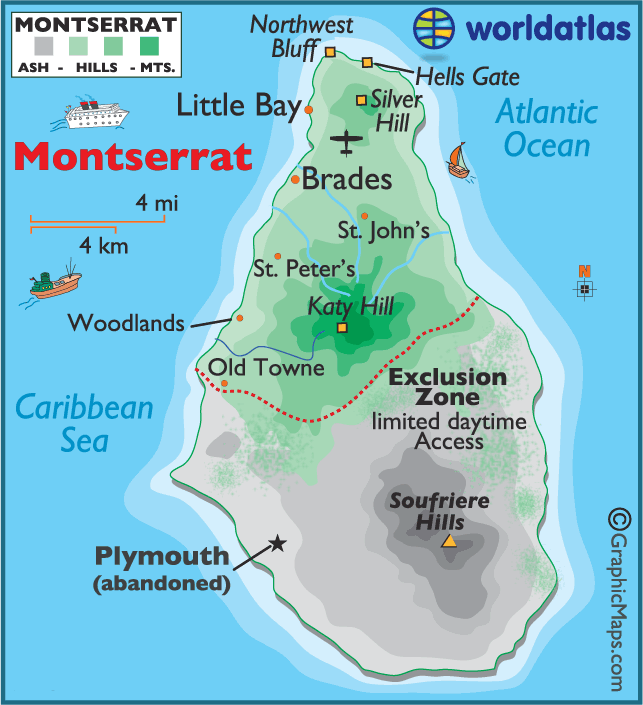
Looking at before and after images was bone chilling.  The volcano itself had changed shape and size dramatically over the years.  The island grew and the bays shrunk.  There is an extensive exclusion zone, decided upon by some the world’s top volcano scientists who are constantly observing and studying the volcano.  There hasn’t been any major activity since 2010 when the dome of the volcano collapsed, but more activity is expected.  

  
It is impressive to see how resilient the local people are who lived through the devastation.  Those people who lived in the area that is now the exclusion zone were set up with emergency housing in public buildings such as schools and churches, living in close quarters with no privacy.  Joe Phillip was one of the many people who lost his home.  He lived in a high school classroom for 2 years before he was able to move to another place.

Many people lived in this high school after the big eruption

After our visit to the observatory we walked back down the mountain to Salem.  We got lost on the way, ending up in a little neighborhood called Hope.  It was a very rural area with fruit trees and goats everywhere.  When we realized we were going the wrong way, we turned back and were approached by a drunk man.  His name was Mickey.  We stopped and talked to him for a half an hour, discussing everything from the volcano to Jesus to good and evil to different kinds of people.  Before continuing on our way, I asked if I could take a picture with him and his goat-herder friend, David.  And I asked David if I could take a picture of his goat herd.

With our new friends Mickey and David in Montserrat
David's goat herd

We walked for about 3 miles, then we decided to catch a bus the rest of the way.  Sometimes I wonder how many miles we have hiked in these flip-flops so far…at least a hundred miles, without a doubt.  A few repairs gluing the soles together, and a few shoe laces strung through when a strap breaks, will get you countless miles out of a good pair of flip-flops!  Thanks to my friend Jim, who repaired my flip flops the first time by drilling two holes through the sole and stringing a string through!

Jim can fix anything.  He's a genius!

It was a wonderful day.  We met lots of locals, enjoyed the natural wonders of the island, and learned tons about maybe the most interesting island in the Caribbean.  We almost skipped Montserrat, what a bad decision that would have been!  It is filled with resilient, kind-hearted people, is breathtakingly beautiful, and so incredibly interesting with its volcanic past and present.  We are very eager to return and experience it in more depth.  Montserrat, we love you! 
     

Thursday, June 25, 2015

OUR FIRST STORM - STATIA

 We left Saba bright and early, just after the sun peeked up over the horizon.  Our plan was to sail to St. Kitts, arriving by around 6 that evening.  Today was the day that we really learned that plans need to be flexible.

We motored away from the island of Saba to get away from the gusty winds.  We decided to put out just our genoa since the wind was strong and the seas were rough.  We got as close to the wind as Salt Whistle would allow us, but we couldn't get a straight heading for St. Kitts.  Only minutes after putting our sail out, the motor died.  Not this again!!!  Thank goodness we had a sail out, because it would have gotten very scary if we ended up beam to the huge waves!  At least having the sail meant some forward momentum and control of our steering. 

Skeeter went down below to troubleshoot our problem.  He decided to change the secondary fuel filter, since that was the only part of the fuel system he had not recently changed.  Sure enough, that was our problem.  After that filter change the engine ran nice and smooth.

This is what the sky looked like ahead of us.  Photo credit: Richard Freeman

Up ahead in the distance, the sky turned an ominous shade of black.  We decided to furl in the genoa and motor straight for St. Eustatius (Statia), the next closest island that marked the half way point in between Saba and St. Kitts.  We did NOT want to get caught in this squall.  Unfortunately, given our many problems and struggles in Saba, we did not have an up to date weather report.  We just knew we were ready to get the hell out of there.  So we didn't know what kind of storm we were getting ourselves into.

The front of what we thought to be "just a squall" hit us.  40 knots of wind with gusts of even more, then a painful wall of water.  The raindrops felt like ice cold pins and needles stabbing into us.  Oh, how we were wishing we had a dodger (windshield) so we didn't have to take the weather in the face like this.     The waves got up to 10 foot (meaning 20 feet from trough to crest), and then the space in front of us went completely white.  We couldn't see a thing, but could hear our hearts pounding over the sound of the howling wind, the splattering rain, and the breaking waves pummeling us in the face.  We reduced speed to where we could still steer, but were not making forward progress. 

The satellite image of the storm we went through, the day after

When we passed the front of the storm (which we later found out was a gale force tropical wave) and we had about 100 feet of visibility we saw a dense blanket of fog over the surface of the water, rising up from the cold rain hitting the warmer sea water.  We had never seen this before, other than on "Pirates of the Caribbean."  The rain was still coming down, and the waves were still crashing.  We were literally shaking from the freezing cold rain, despite the fact that we were in the Caribbean in the summertime.  You know you are freezing when 80 degree sea water being splashed on you feels like warm bath water.  Our predicament was both scary and miserable.  Some decent foul weather gear will definitely be something to add to our wishlist.

We had a short break from the rain and sped up to make progress toward our revised destination, then a second squall (tropical wave) hit us.  We were only about 4 miles out from Statia.  We had been able to see the tall volcanic island since the first storm let up, but then the rain came down in sheets and it completely disappeared from our sight.  So close, yet so far away.  We had to ride the storm out without getting too close to the island.  Trying to approach in almost zero visibility would have been ludicrous.  We could have collided with any number of hazards.  That last 4 miles took us 3 hours.  It was the most miserable, freezing, and terrifying 3 hours for us so far as sailors.

No actual damage was done, though it did give us quite a scare.  We thought we lost our dinghy motor cowling (though it obediently fell off right into the dinghy itself), and we thought we lost 3 of the 5 caps to our water jerry cans because the genoa sheet unscrewed them (though we found them in the gunnel).

Biggest lesson learned: NEVER HEAD OUT TO SEA WITHOUT AN UP TO DATE WEATHER REPORT!!!

Equipment we need to get soon: Foul weather gear, a dodger, and a SSB (Single Side Band) Radio (auto pilot would be very nice, too!)


Statia is a beautiful island, but the one and only anchorage, in Oranjestad, was a miserable one with the current sea conditions.  The wind and the swells were coming in from different directions, and we were beam to the swells.  At times there were 2 foot swells in the anchorage, and we were rocking so hard from side to side that we were once again miserable and exhausted.  

We made 5 different attempts at setting a stern anchor so we could sit facing the swells, but each and every time the anchor would drag from the excessive up and down motion of the swells and the swinging of the variable winds.  We couldn't stand or walk around without getting beat up, bouncing off walls like balls in a pinball machine.  We couldn't even put anything down because it would just go flying across the boat.  Our bed was soaking wet from the horizontal rain and waves crashing in through the cockpit, past the drop board, and into our aft cabin.  We had no choice but to (attempt) to sleep in the salon.  The violent rocking from side to side and the many loud banging noises made it very hard to sleep.  I ended up sleeping on the floor after the whole settee slid out with me on it...I didn't want to fall and crush Momo! 

Even Momo felt sea sick & wished he could get off the boat
One major advantage of Statia over Saba was that the dinghy dock and access to land was close by.  We tried to get our feet on solid ground as much as possible, and even took a nap on a park bench to try to make up for lost sleep aboard.  It was such a relief to get off of the boat.

We made it up to Fort Oranje
You could see the wind howling

Watching Salt Whistle bob from side to side

I tried unsuccessfully to hide the exhaustion from my face

This cannon fired the first foreign salute recognizing the USA's independence in 1776

Statia is a beautiful island with rich nature and history, but we did not get to enjoy it to its fullest due to our exhaustion and shattered morale.  I wanted to take Skeeter hiking into the crater of the big volcano, called the Quill, but we barely had enough energy to even walk around town.  We were exhausted and crabby and about to give up on the cruising life after an entire week of no sleep. 

We are desperately hoping our next crossing is uneventful, and that our next anchorage lets us get some much needed rest!


Monday, June 22, 2015

SLEEPLESS IN SCENIC SABA


We stayed on the overnight moorings in Wells Bay, the only ones available

We checked out of the Capitanerie in Anse Marcel, St. Martin.  We were pleasantly surprised that the huge fire that we saw burning down the mountain when we were in Tintamarre didn't reach the marina, though the smoke smell was quite overwhelming.

We motored out of Anse Marcel and raised our mainsail just outside of the bay.  We unfurled our genoa too.  Our initial course was directly downwind, so Skeeter rigged up a preventer so on our mainsail to avoid an accidental jibe, and we back-winded the genoa to sail wing on wing.  This was our first real opportunity to sail on this cruising adventure, since our previous expeditions were all upwind.  When we were clear of the point just south of Marigot, we jibbed and set a straight course for Saba.


It was difficult to steer a straight course.  We were headed pretty much southwest, so we had somewhat following seas, 4-6 foot waves, and 15-20 knots of wind.  The boat really wanted to turn into the wind, so steering gave our arms a workout.  There are definitely times we wish we could afford an autopilot or a wind vane steering system.  Oh well, c'est la vie!  Maybe after we make some more money.

The Sahara dust was especially thick in the sky, so we lost sight of land quickly.  We should have been able to see Saba early on, but couldn't until we were within 10 nautical miles. 


What Saba would look like in the distance on a clear day
  As soon as we got close to the island of Saba, the wind turned into crazy overpowering gusts.  It would fluctuate between 0 and 50 knots of wind withing a matter of seconds!  Trying to drop our sails was intense and very stressful.  The furler got stuck.  The powerful and uneven gusts were catching us and overpowering us.  I had to carefully crawl out of the cockpit to unjam the furler and release the preventer that was holding the mainsail to one side.  

Being out there on the deck in those unpredictable and powerful gusts and now no preventer attached to the boom put me into a panic about Skeeter accidentally jibbing and I completely lost my brain.  I imagined the boom knocking me unconscious and overboard in the rough and wild conditions.  I yelled at Skeeter to sheet in the main.  He tried to argue with me, but I was extremely persistent so finally he obliged.  I was wrong, but was too panicked to realize it.  Although we are experienced mariners, we are still novice sailors.  

We weren't really close to jibbing, but with the unpredictable gusts I thought we were.  Now he couldn't turn into the wind safely, because the gusts were catching the sail, overpowering us, and pushing us over.  When Skeeter shouted out (and he had to shout because the wind was so damn loud), "The wind's got me!  I'm losing it, I'm losing it!" I somehow interpreted that as, "Oh shit, we're going over!" and in my wild panic I almost jumped over the side to abandon ship.  It's amazing how stupid panic can make people.  He finally managed to turn to face the wind so we could drop the mainsail.  

When the sail was down we had control again, but the conditions were still surprisingly rough.  With my heart still racing and my limbs shaking from adrenaline, I took the helm as Skeeter got ready to grab a mooring.  We had the dinghy pulled up alongside like always when we're maneuvering, to prevent it from getting caught in the propeller.  A strong gust of wind got under the dinghy and it was airborne.  Then the wind caught a solar panel and it almost went flying.  Yikes, what did we get ourselves into by coming to Saba???  

The wind channeled around that corner in powerful gusts

We tried to get some sleep after our extremely stressful day, but it was impossible.  Those crazy gusts of wind and the ripping current going in the opposite direction of the wind made our boat swing all over the place.  We'd spin around the mooring, and the mooring ball would bounce off the hull like Skeeter's college roommate who used to come home drunk and play the drums in the middle of the night.  On top of that, the wind and current would hold us beam to the waves (sideways), making our boat bob like an pendulum swinging back and forth.  Plus the wind would shift and we'd get whipped around and jerked like an abusive dog owner's pup.  Things would fall, bang, rattle, and roll no matter how well we secured everything.   

The boat swinging around and jerking
We got bounced around like balls in a pinball machine.  Simple things like walking, pulling your pants down to go to the bathroom, cooking, and not falling out of bed became Olympic-like challenges.  This was our constant, exhausting reality while in Saba.

The dramatic rocky coast rising straight up out of the water

Getting to shore was a bit of a nightmare, too.  We were obliterated from the exhaustion of not sleeping and our exhausting waking moments, and we were starting to get extremely grouchy.  We tried motoring around closer to Fort Bay, where you check in with customs and the only real place to get on land, but there were no moorings available and seas were even more scary rough there.  We didn't want to drop anchor because it was extremely deep (50+ feet) and the waves would surely yank up all of our chain and our anchor in those nasty conditions.  So we motored half way back around the island to Well's Bay where we started.  

Looking at Ladder Bay from Well's Bay
Winds were still blasting, and both the wind and waves change direction as soon as you round the corner.  This is because the wind and waves wrap around the island.  Around the corner you have to head into the wind and waves, and the island no longer blocks the waves.  The waves are even taller there than in open ocean because of the wrap around effect.  

Arial view of Saba. Photo Credit: "Saba World Wind" by NASA World Wind


I was scared to get into our little 8ft 8hp dinghy to go check into customs.  It was 2 torturous miles.  I imagined our dinghy going airborne with us in it and we'd flip over and end up lost at sea.  Saba is so remote that you could easily drift out to sea unnoticed.  I cried and told Skeeter I didn't want to die.  A little melodramatic, I know, but I was more tired than I had ever been in my entire life and I have a very vivid imagination.  

He calmed me down, and I said I'd go if we brought a handheld VHF radio, smoke signals, an air horn, and a change of clothes in our dry bag.  I really wish we had bought oars for our dinghy.  All we had was a crappy emergency paddle that wouldn't even keep you from getting blown away in those conditions.  Oh well, we hadn't had any dinghy problems lately so we should be fine, right?  I put up our "Q" flag to acknowledge that we still needed to check into customs, changed into swim clothes, and readied our emergency bag.
 
Putting up our "Q" (Quarentine) flag
Getting the dinghy ready

We made it safely to shore, though it was scary.  We were soaked from head to toe; there wasn't a dry spot on us.  We tried to drip dry for a few minutes and were going to try to find a place to change but we were ushered into the customs & immigration office, still dripping wet.  There was a puddle at my feet.  The customs official surprisingly didn't say anything...I guess it wasn't the first time someone walked into his government office like that.  We paid $20 for customs/immigration, found a bathroom to change our of our soaking wet clothes, and then went to the Marine Park office to paid our $12 mooring fee.  

Saba Marine Park Office

Dahlia at the Marine Park was very nice and helpful, and even hooked us up with a ride up the mountain with her friend Lazlo, who was about to head up anyway.  We drove up "the road" (Saba's only road) through the lowest town, "The Bottom," at almost 1000 feet elevation, and to Windward side at about 1500 feet.  Skeeter rode in the back of the truck enjoying the steep scenic ride up and I rode in the cab with Lazlo, getting a lesson in Saba history and culture and he pointed out landmarks along the way.  

Skeeter's view from the back of the truck
A one-of-a-kind island

We went to a restaurant called "Scout's Place" for lunch.  It was our 5 year anniversary, so we treated ourselves to a meal out and an unbelievable view.  We were surprised that what was a violent gusting wind at sea level was but a light breeze in town.  After that tasty meal we were cheering up and coming out of our zombie hazes.  We strolled around the little town of Windwardside, then decided to put out our thumbs and hitch down the mountain to The Bottom.  
 
The view from Scout's Place, 1500 ft down to the sea
A flatbed work truck with a lifting crane in the back stopped for us and told us to jump in the back.  He said we could stand and hold onto the crane.  It was the most exhilarating experience ever!  Skeeter and I were both grinning from ear to ear.  We both agreed that it even beat the time in the Philippines when we got to ride on the roof of the jeepny bus.  It was like a roller coaster ride!  The view was a thing of dreams and nightmares combined in one.  

Looking down at The Bottom
Photo credit: Simon Wong
Wind was blowing through our hair while we looked over the edge of sheer cliffs dropping down 1500 feet to the sea, and looking down hundreds of feet to The Bottom, where the houses and people looked like ants.

Goats roaming around town
A cute Saban church
Skeeter in front of the one and only Police Station
We walked around The Bottom and enjoyed the postcard perfect town.  The buildings mostly all painted white with green trim and red roofs.  The streets were all clean and paved, surrounded by stone walls.  Even though the island was experiencing a drought, it was still lush and green, with explosively colorful flowers.  

A street corner in Saba
Skeeter with a Flamboyant tree along "the road"
After exploring, we picked up a few groceries (peanut butter chocolate Oreos for our anniversary dessert), and then decided to walk down "the road" from 1000 feet down to sea level. 

"The road" going from The Bottom down to the water
We changed back into our soaking wet clothes and got into our dinghy to head back to our miserably bobbing boat.  We were almost out of the protected dinghy dock area when our motor died.  We were about to get pulled out into the huge windy wavy seas, but I grabbed our emergency paddle and started paddling like a maniac and Skeeter tried to get the engine to start.  My eyes started to fill with tears.  The sun was almost setting and we could be lost at sea for our 5 year anniversary.  Fantastic.  We finally managed to get tied up to the dock again.  Skeeter struggled with figuring out what was wrong with our motor (maybe salt water got into the fuel on our rough ride over?) and I just sat there thinking about our limited options.  
 
Fort Bay - we were almost in open water when our dinghy died
Finally I caught the attention of a kind Saban who must have felt sorry for us.  He offered his engine troubleshooting ideas to no avail, and then suckered two other guys who were working on their boat into giving us a tow back to our boat.  I could tell the captain was not thrilled.  It was a Friday evening and he was ready for the weekend, not wanting to tow some stupid sailors back to their boat half way around the island.  But he did anyway.  And I was extremely grateful.  He warmed up to us by the end of the tow, especially after I gave him a generous thank you tip and told him he might have just saved our lives and that it was our 5 year anniversary.  Thank goodness for those guys.

Getting towed back to Salt Whistle

Trying to remain positive as we celebrate our anniversary with our Funny Pop "Champagne"

Unfortunately that night, and all other nights while on Saba, were sleepless ones.  The next day we just vegged around, unable to move from exhaustion.  It was very sad and disappointing, because we had wanted to hike Mt. Scenery, Saba's tallest point.  But there was no way we had the steam to make it up that mountain in our state, and our dinghy wasn't working anyway so we couldn't even get to shore.

So many cool hikes on Saba - Photo credit: Richie Diesterhef
The following day, Skeeter fixed the dinghy (there was an air leak in the fuel pump) and we went back ashore to clear out of customs.  

Skeeter troubleshooting & fixing the dinghy

We didn't bring much of anything with us except for our passports, since we just planned on checking out and then coming back to the boat.  No dry clothes, no phone or camera, no water bottle.  But alas, the customs agent just left and wouldn't be back for another 3 hours.  No way were we going to go back to the boat.  The ride over was long and treacherous.  I was near tears again.  I just wanted to collapse.  It was a Sunday so the island was like a total ghost town.  There wasn't even anywhere to sit down, since Fort Bay is a dusty dirty mining area.  I seriously considered just laying down to rest in the street.  I didn't know what to do.  

Luckily, after many attempts, Skeeter managed to convince me to conjure up my remaining nuggets of energy and make the most of the 3 hours we had.  So we bought water at the Dominican bar in Fort Bay, hiked 1000 feet up "the road" to The Bottom, and strolled around town.  It was a real shame we didn't even have our phones to try to get internet to check the marine weather forecast, but nowhere had open wifi in Saba anyway and everything was closed because it was a Sunday anyway.  Then we hiked down the path to the historic old customs house at Ladder Bay.  

Looking up at the "ladder" and old customs house from the boat
I thought my legs were going to give out from under me I was so drained, but they didn't.  We walked back through The Bottom and down "the road" to Fort Bay in perfect time to check out of customs.  The dinghy worked this time, and brought us safely (though very wet) back to our boat.


We hadn't even been able to enjoy the beautiful underwater world that Saba offers due to lack of money to pay for diving (it's required to go with a dive shop), rough seas, lack of a working dinghy, and lack of energy.  We whipped up our last bits of energy and went for a snorkel at Well's Bay.  The underwater topography was stunning and dramatic, the corals healthy, and the fish were plentiful.  We swam through a tunnel carved through the rocks, and free-dived down to get close to the fish and look under ledges. 

Well's Bay - Photo credit: Eveline de Vree
We saw a turtle, a ray, and lots of fish - Clark Anderson/Aquaimages
Our free-diving skills are to the point that we can almost see just as much as we can scuba diving anyway.  We just can't stay down quite as long ;)  The only downfall of the experience was the abundant jellyfish, and my skin is highly sensitive to their stings.  I could care less about the initial pain of the stings, as intense as it can be, it's the excruciating itching that I get for days afterwards that I cannot stand.  
 
Current spun us beam to waves as the sun set on Saba
Back at the boat we got tossed around as usual, and then had another sleepless night.  At least we'd be leaving first thing in the morning!  We couldn't wait to get to calmer waters.  

Momo was scared of the powerful gusts of wind
Even Momo didn't like being on the boat in Saba.  The gusts were too much for him.  We didn't want him to get blown away (I think this was a legitimate concern, seeing how our dinghy literally flew), so we never let him outside without close supervision.  He'd get scared of the wind and run back into the cockpit or inside anyway, and outside on deck is usually his favorite spot.  
 
Ferry goes between Saba & St. Martin
If we could do it over we would never have brought Salt Whistle to Saba.  Instead, we would take a ferry from St. Martin and visit for a day, or stay on land if we wanted to visit for a couple of days.  Then we would have only positive things to say about Saba, and could enjoy it for the nature paradise that it is.  It's just NOT a place for cruisers unless the seas are completely flat and there is no wind, in my very bruised and exhausted opinion.