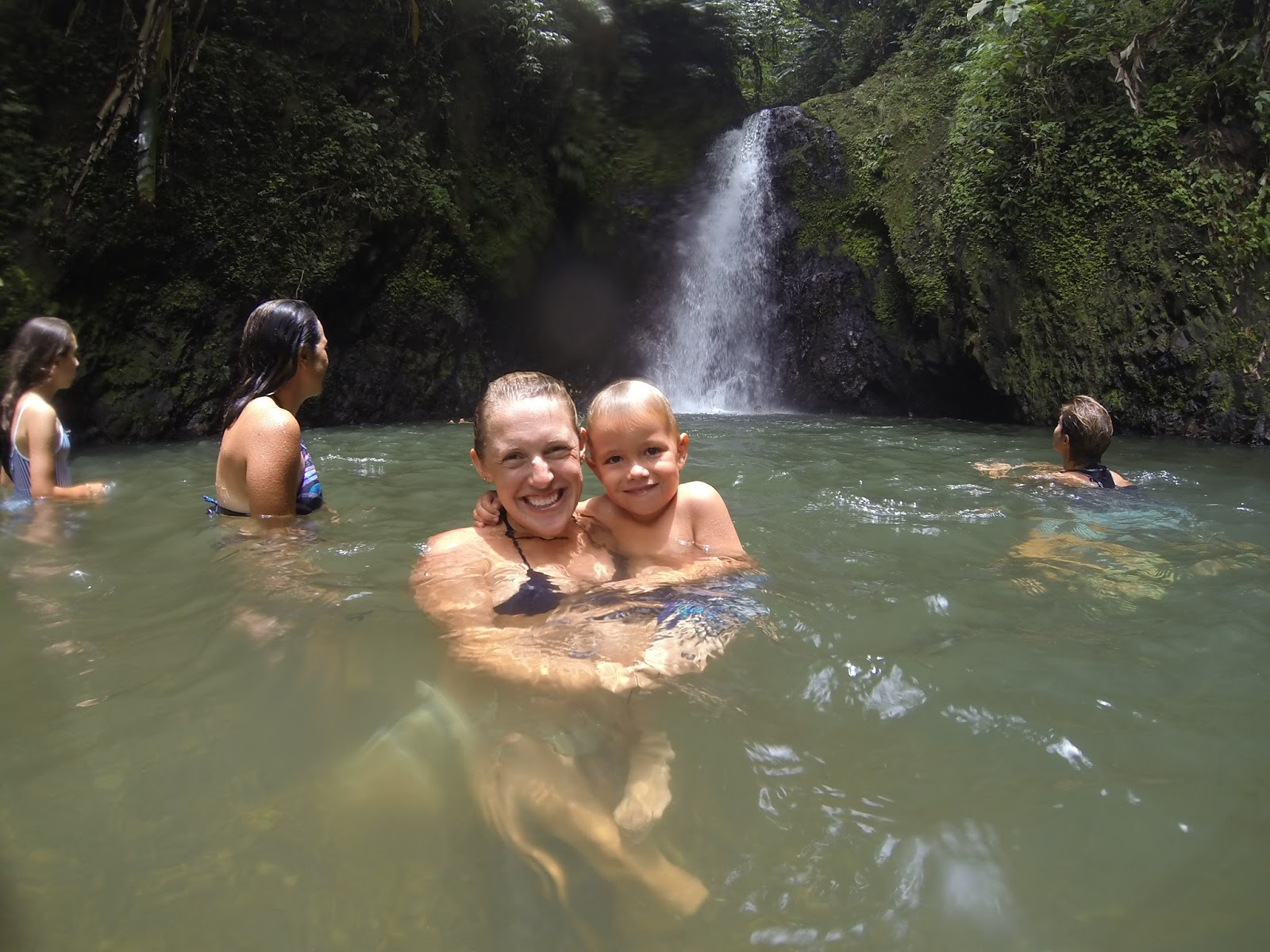
We went on a wonderful group trip to the Seven Sisters Waterfalls,
1900 feet up the South East mountain of Grenada. Devon, a charismatic Grenadian man of many
talents, was our driver, guide, and “oil down” chef. I’ll explain more about the oil down
later. Thirteen adult cruisers plus a three
year old and a baby, along with a cooler and bags filled with our lunch
ingredients, packed into a red mini bus.
Devon first picked up the cruisers from Mount Hartman Bay, and then came
by Prickly Bay to get the remainder of us.
 |
| Skeeter keeping lunch from sliding around |
 |
| Devon's red mini bus |
The van was packed full, and we were all amazed that this
vehicle would be able to conquer the steep mountainous roads of Grenada with
all of our weight in it. Just as we were
pulling out of Prickly Bay marina up the steep driveway, we heard a metallic clamor. Devon, who never shows signs of stress, and
seems to be prepared for anything, got out to see what had happened. We all looked at one another a little bit
worried, but shortly Devon climbed back into his right side drivers’ seat and
declared, “It was just the spare tire.”
And we carried on. We made a
short stop at a store so some cruisers could pick up some beer to add to the
cooler. It was very hot in the van in
the midday heat, but everyone seemed content, chatting away with friends old
and new.
 |
| Everyone packed into the mini bus |
The journey up the mountain was steep, windy, and
beautiful. Though these roads were main
roads for Grenada, you would never guess it because they seem far too narrow to
allow for traffic in both directions.
And often times there are steep mountain drop-offs, stray dogs in the
road, kids riding their bikes in the road, and many other obstacles to contend
with. They winded through small
villages, plantations, and jungle.
Having
previously studied the map, I realized that a two dimensional map could never
really give you an impression of what the roads would be like. Devon drove these roads with extreme skill,
passing other vehicles or allowing others to pass without putting our lives in
danger. He cheerfully chatted away with
the passengers in the front seat with him, telling them all about Grenada and
local culture. Having been a passenger
on many buses in Mexico, Central America, the Caribbean, and South East Asia,
I wouldn’t hesitate to say that Devon is one of the best drivers I have seen.
 |
| The roads are much steeper and windier than they appear! |
After the long and scenic drive, Devon pulled into a narrow
muddy road. He stopped beside a small
house in the middle of the jungle and paid our entrance fees (5EC per person,
equivalent to about $2 US), since the waterfalls are on private property and
the landowner is kind enough to let us enjoy the natural beauty of the
falls. The landowner gave Devon 13
sticks, and we continued down to the end of the muddy road. We got out next to a hut made from bamboo and
palm fronds. We were each given a stick. Oh! They
were hiking sticks. I had never really
used a stick to hike and didn’t really think I would need it, but I grabbed one
anyway. Devon stayed behind to prepare
our “oil down” lunch.
 A family of five arrived in their rental car and joined our
group. They were wonderful people, and I
was pleased to find out that they were Spanish speakers (though quite fluent in
English as well). I go through a sort of
withdrawal if I don’t get to speak Spanish for a long time, and it had been
many months. I enjoyed chatting and
joking with them. Now there was a wide
range of ages and a few different nationalities represented in our group. We were American, Canadian, Norwegian, Dutch,
Grenadian, Peruvian, and Argentinian.
Diversity makes me happy. It just
makes things so much more fun and interesting.
A family of five arrived in their rental car and joined our
group. They were wonderful people, and I
was pleased to find out that they were Spanish speakers (though quite fluent in
English as well). I go through a sort of
withdrawal if I don’t get to speak Spanish for a long time, and it had been
many months. I enjoyed chatting and
joking with them. Now there was a wide
range of ages and a few different nationalities represented in our group. We were American, Canadian, Norwegian, Dutch,
Grenadian, Peruvian, and Argentinian.
Diversity makes me happy. It just
makes things so much more fun and interesting.
 |
| A really nice group of all ages & backgrounds |
 |
| Our hiking group |
Our hiking guide was an energetic little Grenadian man named
Kenny. Surprisingly, his footwear of
choice was slipper style flip flops. One
of the local women told us that he is hard of hearing, which helped us to
understand his mannerisms, why we struggled to understand what he was saying,
and that we should talk loudly and facing him if we have a question. He gestured for us to all come close, so we
gathered around closely. He pulled a
couple of leaves off a nearby tree and tore them, gesturing for us to smell
them. He did this various times throughout
the hike, showing us callaloo, nutmeg, turmeric, mahogany, and many other
local plants.
 |
| Kenny, our hiking guide |
 |
| Kenny showing us callaloo |
The hike was surprisingly steep and muddy, and now it made
complete sense why we were each given a stick.
Apparently the trail can be much worse, but we had come on a day that
was relatively dry for the Grenadian highlands.
We climbed up and down steep muddy hills, past impressive trees,
majestic bamboo, and abundant bromeliads. On the way down a set of steep mud steps
terraced out of the mountainside, we were shown to hold onto the wooden “handrails.” Seconds later, while someone was using one of
the wooden handrails for balance, it detached itself and went sliding down the
steep slope. Okay, I guess we shouldn’t
count on the rail too much! It was just
a wooden board held to another wooden board by one or two nails.
 |
| Muddy slippery path |
 |
| Don't trust the hand rails! |
 |
| It was a very steep and slippery path |
Skeeter and I wore our Vibram five-fingers, or “monkey feet,”
as my dad calls them. These are great
for hiking, and really give us an advantage to be able to grip slippery spots
with our toes, and to be able to comfortably tread right through water instead
of having to try to balance over wet slippery rocks. This allowed us the ability to lend a hand to
others who had less than ideal footwear and were struggling not to slip and
fall. Plus, it is kind of ingrained in
us to help out. It feels wrong not to
help. We’ve been working in the service
industry teaching scuba diving and crewing on boats for so long we are well
attuned to people’s needs and preventing accidents before they happen. It’s no fun for anyone if there is a medical
emergency. The parents in the group were
probably a little bit worried that their kids might get hurt, or heaven forbid,
slide down the mountainside. Our hiking
guide, Kenny, would run to the back of the pack and lend a hand whenever he
could. It did make me nervous, though,
the way he’d pick up the little kids and lift them over slippery rocks or mud
while wearing slipper flip flops.
 |
| Kenny hikes this trail daily in flip flops |
We finally arrived at the breathtakingly beautiful
waterfalls. Although the distance of the
hike was not too far, it was strenuous.
It was much more steep and slippery than most of us had imagined. We felt we had earned our reward, and were
ready to go for a refreshing swim in the natural pool and wash the mud off of ourselves. The water was cool and crisp, but felt
amazing on our hot, sweaty skin. There was
a big waterfall emptying out into a swimming hole, and then a smaller waterfall
cascade into a lower pool. There was a
ledge in the upper pool that was shallow enough to stand on. As you approached the big waterfall, you
reached a shelf where the bottom dropped off and you could no longer stand. It was nice to swim over to the waterfall and
stick your head under it….though the thought did cross our minds that it would
really suck if a tree branch or a coconut were to be washed over and crack us in
the head. So needless to say, we didn’t
keep our heads under the force of the falling water for too long!
 |
| We can see the waterfall! |
 |
| Skeeter, Jen & Jody |
 |
| It was well worth the hike |
 |
| Now time for a swim! |
Most of us enjoyed swimming around just in the big pool, but
a couple of brave guys decided to jump from the top of the second waterfall
into the lower pool. A couple of us ladies
decided to give it a try, but our intuition told us not to. We weren’t afraid of the jump, but when we
climbed over the rocks to the “jumping platform” and tried to step down onto
it, it was clear that it was a bad idea.
The starting point was covered with wet slippery moss, and on a sharp
angle. Had it been mossy but flat, or
angled but good grip, I have no doubt we would have done it. But the way it was, I was 90% sure that I
would slip before I even tried to jump, and I’d bounce my head and body off the
rocks numerous times before splashing into the pool. Absolutely NOT worth it. Especially when you don’t have insurance!

There are more waterfalls further down the trail (7 in
total), but the majority of the group was perfectly content with the refreshing
swim and the two waterfalls we saw. I
think the dominant thought in most people’s minds was, “We haven’t broken
anything yet today. Let’s keep it that
way!” Plus, I couldn’t imagine how
difficult and nerve racking it would be to hike over the steep slippery parts
with a baby strapped on your back, or worrying about your little kids wandering
too close to the edge.
When we returned to the trail head we could smell the
delicious “oil down” lunch boiling on the wood fire. Devon had been working very hard while we
were gone. He explained the “oil down”
to us, and it’s many ingredients. It’s
called an “oil down” because of the natural oils that come from the coconut
milk. In a big pit over a wood fire, he combined
the ingredients: coconut milk, breadfruit, callaloo, carrots, dumplings, lots
of spices including turmeric and curry, and lots of meats including salt fish, pork,
chicken, and turkey. It all stewed
together and boiled over the fire for a long time to make it very flavorful.
 |
| What's that delicious smell!!!??? |
 |
| Devon checking to see if it's ready |
 |
| It's looking good! Who's hungry? |
While the oil down finished cooking we rehydrated and
chatted with one another, enjoying the atmosphere. It was an overcast day, and seemed to be threatening to rain all day, but it never did.
This was great though, because it helped keep the temperature more
comfortable. We were surrounded by lots
of plantation trees, including banana, papaya, pineapple, breadfruit, sugar
cane, star fruit, and French cashews, a very perfumy fruit that looked like a reddish pear.
I tried this fruit for the first time, and it was very good. Near the seed was something that seemed
spider webby to me. I took one more
bite, and then realized that I had come within less than a millimeter of eating
a spider. Oops! Ha, ha!
 |
| Socializing as the oil down finishes cooking |
| | |
 |
| Inside a French Cashew |
|
 |
| The spider I almost ate |
 |
| By Lee Coursey (Nutmeg Closeup Uploaded by Rojypala) [CC BY 2.0 (http://creativecommons.org/licenses/by/2.0)], via Wikimedia Commons |
When the oil down was ready, Devon served up a heaping
portion to each of us. It was
delicious. It tasted similar to a Thai
or Indian coconut curry, but wasn’t spicy. I was surprised that I was able to polish off the
whole mound of deliciousness. Of course
I did have some help from my canine friend, who was eager to help all of us
with the meat left on the bones.
 |
| The callaloo and dumplings floating on top |
 |
| Devon serves each of us a hefty helping |
 |
| This is some good stuff! |
Our bellies full and content, we all piled back into the
mini bus and Devon took us back toward the L’Anse Aux Epines using a different
route. He wanted to get to show us as
much of his beautiful island as possible that day. He took the Annandale and Grand Etang route through
the middle of the mountains on the way there, and he took the Grenville and
Westerhall southeast coastal route back.
 |
| The orange line indicates our path |
We passed by a funeral procession, and there were tons of people walking
down the road from the funeral home to the cemetery. Devon explained to us that Grenadians love attending
funerals because they love to dress up…very interesting cultural quirk.
Shortly before we reached Grenville, I
noticed Devon put his seat belt on.
Having spent lots of time in the Caribbean I was sure that this meant we
were approaching a police station. I was
right. Two uniformed women officers, in
their police skirts, were stopping cars and checking for seat belts in the front
seat. She scolded Devon because his
passenger was not seat-belted, say that he knows better, but did not issue a
citation and let us carry on.
Devon pointed
out the big fish market and other places of interest to us. We talked about the extensive piles of
sargassum sea weed piled up all along the east coast, and how unpleasant and
unhealthy it is. It was very stinky, but
did not compare to the mountains of it was witnessed being piled up by
excavators on the beaches in St. Kitts.
 |
| Sargassum sea weed on the beach |
 Suddenly the bus started making a hissing noise. We pulled over on the side of the road next
to a little house in Grenville, where a lady was drying her laundry by
spreading it over the tops of her hedges.
The bus was overheating. I guess
our weight plus all of the weight of the delicious oil down lunch in our bellies
was too much for this little bus to take on these steep hills.
Devon did what he could to cool down the
engine by pouring water into the radiator, and then we all got back into the van and he
drove a bit slower and called his brother. Minutes later we pulled over again, and there
was his brother with a shiny bus. We all
piled out of bus #1 and into bus #2, and Devon hopped back into the driver’s seat. It was impressive how fast and smooth the
transition was.
Suddenly the bus started making a hissing noise. We pulled over on the side of the road next
to a little house in Grenville, where a lady was drying her laundry by
spreading it over the tops of her hedges.
The bus was overheating. I guess
our weight plus all of the weight of the delicious oil down lunch in our bellies
was too much for this little bus to take on these steep hills.
Devon did what he could to cool down the
engine by pouring water into the radiator, and then we all got back into the van and he
drove a bit slower and called his brother. Minutes later we pulled over again, and there
was his brother with a shiny bus. We all
piled out of bus #1 and into bus #2, and Devon hopped back into the driver’s seat. It was impressive how fast and smooth the
transition was.
The rest of the drive back to the marinas was smooth sailing.
Lots of heads were starting to bob as
people were starting to drift off into sleep.
It was a long but wonderful day of Grenadian nature and culture, delicious
food, and spending time with friends old and new.
We were very happy we decided to join a group
tour, even though this usually isn’t our style or within our budget. The whole day only cost us $50 EC ($20 US) each,
plus tips for our wonderful guides. And
this included our lovely Grenadian oil down lunch! Most other places the lunch alone could cost
that much! Even though we enjoy being
independent travelers and doing things on our own, I would definitely consider
doing something like this again!